
Let’s be honest: interviewing is its own weird sport. You can be crushing it as a PM, shipping features, unblocking teams, making users happy, and then walk into an interview room and suddenly forget how words work.
Interviewing isn’t the same skill as building product. It’s a performance under pressure, with incomplete information, and the stakes feel high because they are. Your next role, compensation, and trajectory are all on the line.
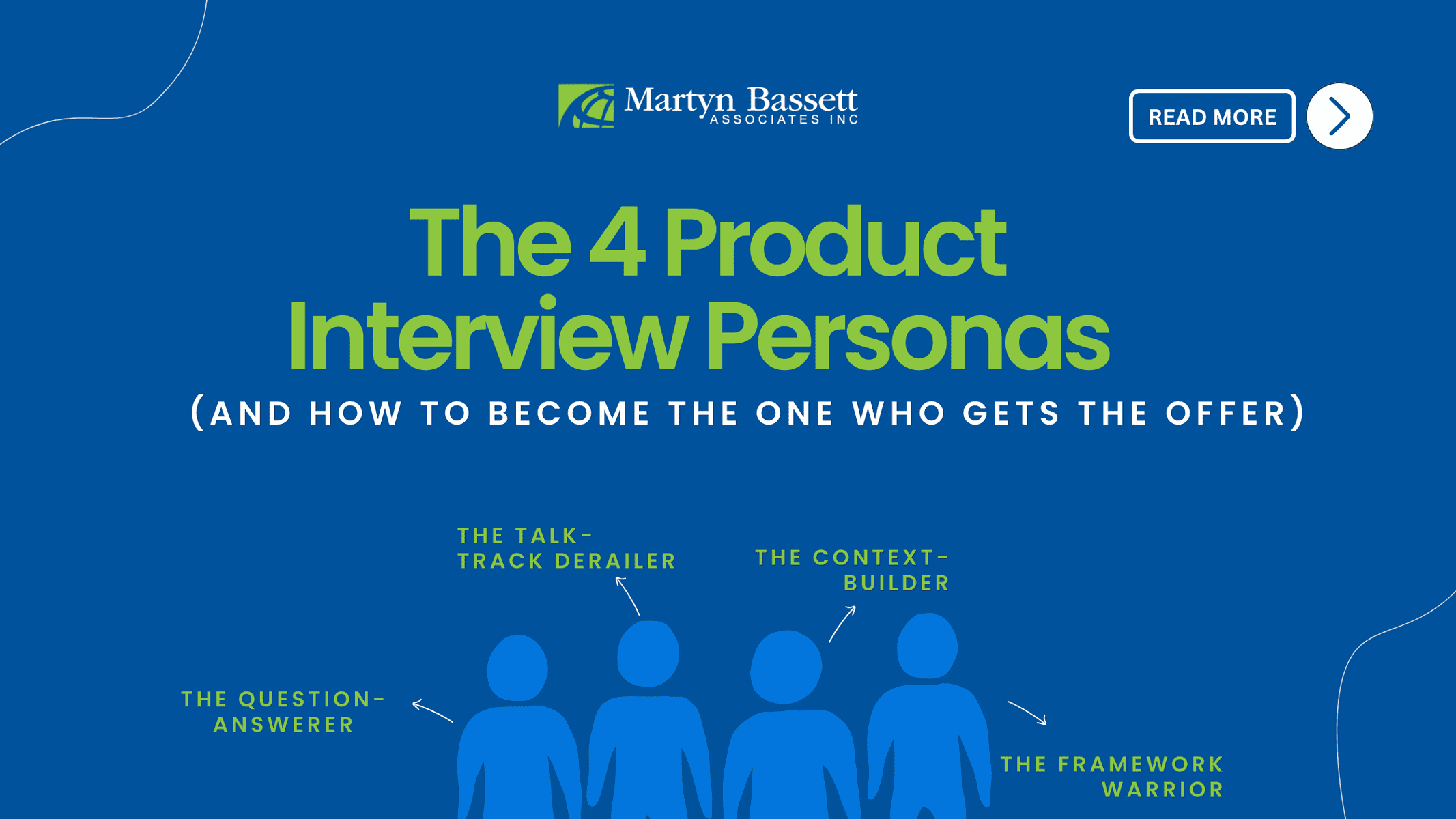
After nearly two decades recruiting product managers and product leaders into startups and scaleups, I keep seeing the same pattern: candidates tend to fall into one of four personas. And the persona you bring into that room? It basically decides whether you get the offer or the dreaded “we’ll be in touch.”
The good news: personas are habits, not destiny. Once you see yourself in one of these, you can shift.
Persona 1: The Question-Answerer
The vibe: This candidate answers exactly what was asked (clearly, directly) and then stops.
Example exchange: “Tell me about a product you shipped recently.” They describe a product they shipped recently: what it was, the problem space, and roughly what they did. Then… silence.
Why it happens: For early-career PMs and career switchers this is actually a healthy baseline. You’re staying on topic, you’re not rambling, and you’re giving the interviewer something concrete to work with. That already puts you ahead of candidates who can’t land the plane.
The ceiling: You’re only meeting the minimum bar. Startup founders and product leaders aren’t just checking if you can narrate a project, they’re trying to understand your judgment, your learning loop, and how you collaborate when things get messy or political. A pure Q&A style keeps your answers flat and transactional. It doesn’t create a memorable story in the interviewer’s mind.
How to level up:
Keep your direct answer, then add one or two layers:
- Briefly set context: the business situation, constraints, and stakes
- Call out 1–2 key decisions you made and the trade-offs involved
- Close with what changed because of your work (before/after, metric shift, or qualitative outcome)
Now you’re not just answering; you’re teaching the interviewer how you think and operate.
Persona 2: The Talk-Track Derailer
The vibe: This candidate technically responds, but they don’t really answer the question. Instead, they slide into a memorized narrative, a lengthy career tour, or a “greatest hits” reel they’re determined to deliver no matter what was asked.
“Great question… why don’t I start by walking you through my background, beginning in 2008 when I graduated from…”
Why it happens:
This usually comes from a real place:
- You’re nervous and worried about going blank
- You’ve done a ton of prep and feel pressure to “use” it
- You’re more comfortable with a script than thinking out loud
The problem: It breaks the contract of the conversation. The interviewer is there to test for specific signals: Can you solve these types of problems, at this stage, with this team and business model? If you redirect everything back to your favorite stories, they end up with gaps in their assessment. Gaps equal risk, and risk rarely gets the offer.
Extra pitfall for senior candidates: Over-weighting your early career. That heroic turnaround you led eight years ago? It’s less relevant than how you handle messy stakeholder alignment or resource constraints right now. Recency bias is real; founders care most about your current altitude of thinking and your recent pattern of outcomes.
How to evolve:
- Pause for 1–2 seconds after the question; repeat or paraphrase it back
- Answer the question directly in 1–2 sentences before adding any context
- Ask permission if you want to share a broader story: “I can also share a quick example from an earlier role if that would be helpful… would you like to hear that?”
You’ll feel more grounded, and the interviewer will feel respected and heard.
Persona 3: The Framework Warrior
The vibe: This is the candidate who has studied every PM interview framework under the sun and is determined to deploy them all.
They show up to an 80-person startup interview with:
- CIRCLES for product sense
- AARRR for growth
- STAR on loop for every behavioral question
- Highly polished whiteboard performances and perfect structure
Here’s the thing: There is nothing wrong with structure. In fact, strong product sense interviewing advice explicitly teaches you to break problems down logically and cover users, strategy, and trade-offs. The issue is when the framework becomes the star of the show instead of your actual thinking.
From a founder’s perspective, this can feel like being “handled.” They may be wondering: “Why are they talking to me like I’m running a big-tech loop? We’re trying to find product-market fit and survive the next 18 months.”
Early-stage leaders tend to optimize for:
- Authentic, unscripted collaboration
- Understanding of the actual business: revenue model, customer reality, constraints
- The ability to think from first principles when there is no playbook
If every answer sounds like it’s coming from a bootcamp playbook, you risk signaling that you’re more fluent in interviews than in a messy startup reality.
How to keep the upside without the downside:
- Use the framework in your head as a checklist, not as a recitation
- Speak in natural language, not acronym soup; translate CIRCLES into “let me clarify the user, their problem, and what success looks like”
- Adapt to the company’s stage: at pre-PMF, spend more time clarifying the problem and assumptions; at growth stage, lean more into metrics, experimentation, and scaling
You’ll still be structured, but you’ll sound like a business driver, not a case-study actor.
Persona 4: The Context-Builder (The One Who Usually Gets the Offer)
The vibe: This candidate combines clarity with curiosity. They answer the question, but they also actively shape the conversation to reflect how they work in real life.
A senior-level response often has three beats:
- Clarify context: “Before I jump in, here are a couple of things I’d usually want to understand so we’re solving the right problem…”
- Provide a crisp answer, grounded in a real example, with clear decisions and trade-offs
- Ask a thoughtful, relevant question back that pushes the conversation into collaboration
Why this works: This persona signals maturity and leadership quickly. It shows that:
- You don’t assume context; you surface it
- You recognize that wrong-problem execution is more dangerous than slow right-problem execution
- You default to partnership; your instinct is to co-diagnose and co-design, not just “win the interview”
Founders and C-level leaders often describe their favorite hires in this language: thoughtful, peer-like, someone whose questions made them think differently about their own business. That’s exactly what the Context-Builder persona does in the room and it quickly builds trust that “this is what it would feel like to work with you.”
How to intentionally move into this persona:
- Thinking out loud: narrate how you’re structuring the problem and why, not just the final answer
- Asking 1–2 high-leverage questions in almost every answer (about users, constraints, success metrics, or team dynamics)
- Tying your stories back to business outcomes and learning, not just features shipped
You are still “interviewing,” but the experience for the interviewer feels more like collaborating with a future employee.
How to Shift Your Persona (With Concrete Moves)
Here are simple ways to practice moving toward Persona 4, no matter where you’re starting from:
For Question-Answerers:
- Add a one-sentence “why this mattered” to every story (business or user impact)
- Call out one key decision and the trade-off you made
For Talk-Track Derailers:
- Write down 5–7 likely questions and one tight, 2–3 sentence direct answer for each
- Practice stopping after your answer and waiting for the interviewer to pull for more
For Framework Warriors:
- Do mock interviews where you are banned from using acronyms; talk like you would to an engineer or founder in a 1:1
- Tailor one version of your style for early-stage (more discovery, ambiguity) and one for later-stage (more metrics, scale)
For Aspiring Context-Builders:
- Before every interview, write 3–5 thoughtful questions about their users, business model, and product strategy; aim to weave 1–2 into each conversation.
- After each interview, jot down where you defaulted to “performing” instead of “collaborating,” and how you might answer differently next time.
Over time, these micro-tweaks compound into a very different presence.
Your Turn: Share Your Signals
If you’ve been interviewing recently, what have you noticed about how you show up, and how interviewers respond? If you’re a hiring leader, what specific signals make you think “this person will thrive here,” beyond the resume? Drop your experiences and patterns in the comments so other product people can learn from them.