
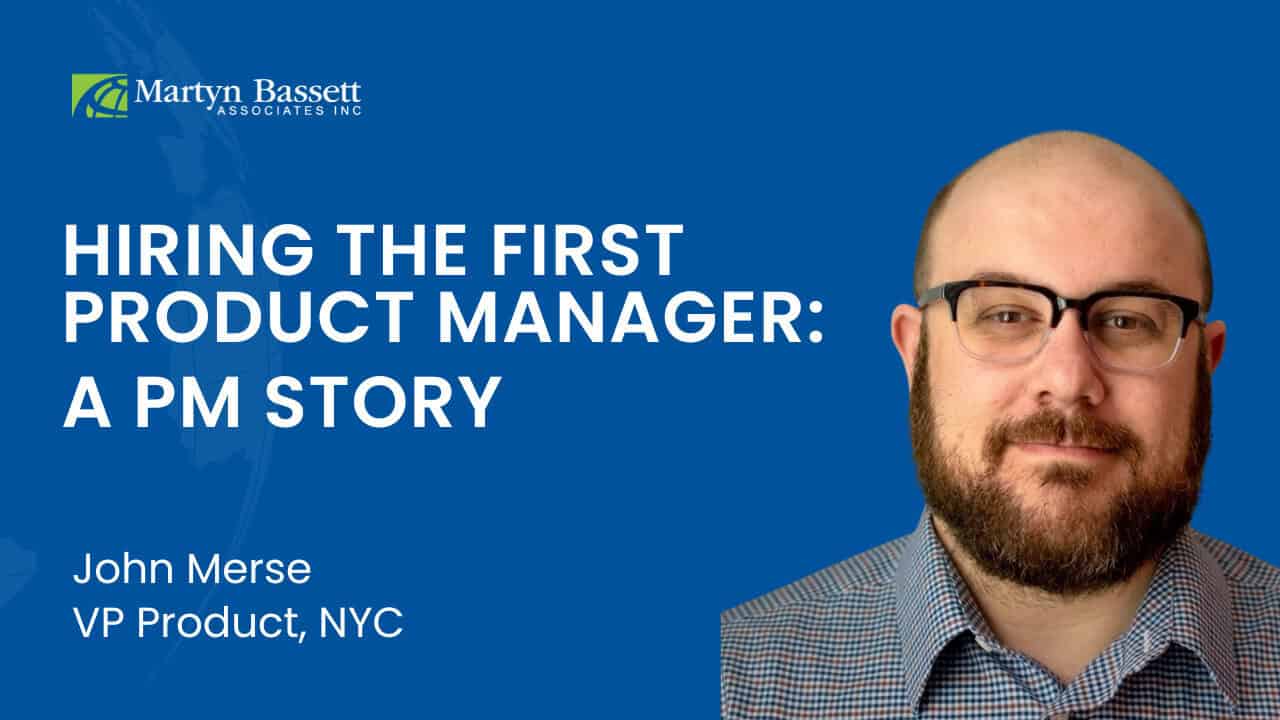
Hiring a first product manager is rarely just a staffing decision. For most founders, it marks the moment when building a company starts to require a fundamentally different kind of thinking about priorities, trade-offs, and how the product grows.
To understand how that transition plays out in practice, we spoke with John Merse, a VP of Product based in New York City who has repeatedly been the first product hire at founder-led startups.
Across multiple companies, John has worked at the intersection of SaaS platforms, CRM systems, and AI-enabled customer experience products. His career includes helping scale a CX CRM platform that grew to roughly $60 million before being acquired by Meta, as well as building voice AI products from the ground up in the hospitality industry.
The thread running through his career is consistent: he joins companies at the point where an early product idea needs to become a scalable business.
When the Need for Dedicated Product Management Becomes Apparent
In many startups, the case for a dedicated product manager builds gradually rather than arriving all at once.
One example from John’s career began while he was working in marketing at a small agency serving multiple industries. While reviewing the company’s revenue data, he noticed that nearly 60 percent of it was coming from real estate clients. That finding prompted a strategic conversation with the founders about whether the agency should narrow its focus and build software products specifically for that market.
At the time, the company had no meaningful SaaS experience. Its model was built around project work, contracts, and hourly billing. A shift to software meant moving to recurring revenue, where customers pay monthly for ongoing access to a product. That change had implications far beyond engineering.
The team had to decide what functionality the product would include, which components to build internally, and what could be integrated from existing tools or open source systems. As the product gained users and usage grew, the need for structured product leadership became hard to ignore. That is typically the moment when a startup’s first PM role takes shape.
Product Is Not a Delivery Function
One of the most common mistakes founders make when hiring their first PM is treating the role primarily as one of execution. In this view, the founder sets the direction and the product manager carries it out.
John’s experience points to a more expansive model. The strongest product hires operate as genuine business partners to the founder rather than project managers for the roadmap.
When a company introduces a new product capability, the effects rarely stay contained within engineering. Pricing may need to be revisited. Customer onboarding may become more complex. Support teams may need additional resources to handle new workflows. A product leader helps identify these downstream effects early and works across the organization to address them.
In early-stage companies, that scope often extends further still. John has frequently been asked to step into problem areas well outside traditional product responsibilities, whether in customer experience, sales operations, or data strategy. The expectation, consistently, was to break the problem down, align the relevant stakeholders, and help the company move forward.
The Founder and the First PM
Few relationships in a startup carry as much weight as the one between a founder and their first product hire.
Founders bring deep personal investment to their product. The idea often represents years of work, significant financial risk, and a great deal of identity. That level of ownership is valuable, but it can also create blind spots when it comes to trade-offs or competing priorities.
A strong product leader introduces a counterbalancing perspective. John describes the relationship as intentionally dynamic: founders may want to push quickly toward new opportunities while product leaders surface operational constraints or raise questions about sequencing. When trust is present, that friction becomes productive. It leads to sharper priorities, better-aligned teams, and stronger decisions as the company grows.
What to Actually Look for in a First PM Hire
For founders evaluating their first product hire, John’s advice cuts against a common instinct: do not over-optimize for process.
Many early-stage companies believe they need someone who will immediately bring formal frameworks, detailed specifications, and structured tooling. Those things have their place, but they are not what matters most in the early stages of building.
What matters more is mindset. The right first PM will show genuine interest in the problem the company is solving, curiosity about the people it serves, and the ability to make progress in conditions that are ambiguous and constantly shifting. They will think about the whole business, not just the feature list.
Process can always be added. What is much harder to develop in someone is the combination of customer empathy, business judgment, and resilience that early-stage product work demands.
Hiring your first product manager is one of the most consequential decisions a founder will make, and if John’s experience is any guide, the companies that get it right share one thing in common: they stop thinking about the role as execution support and start thinking about it as a true business partnership.
The right first PM won’t just manage your roadmap. They’ll challenge your assumptions, connect the dots across your organization, and help you build something that scales. That kind of person exists, but finding them takes more than posting a job description.
Ready to Find Your First Product Manager?
At Martyn Bassett Associates, product management recruiting is our largest and most established practice. We are embedded in the PM community and know how to identify the rare candidates who bring the mindset, judgment, and resilience that early-stage companies need most.
Let’s talk about who you’re looking for and how we can help you find them.