
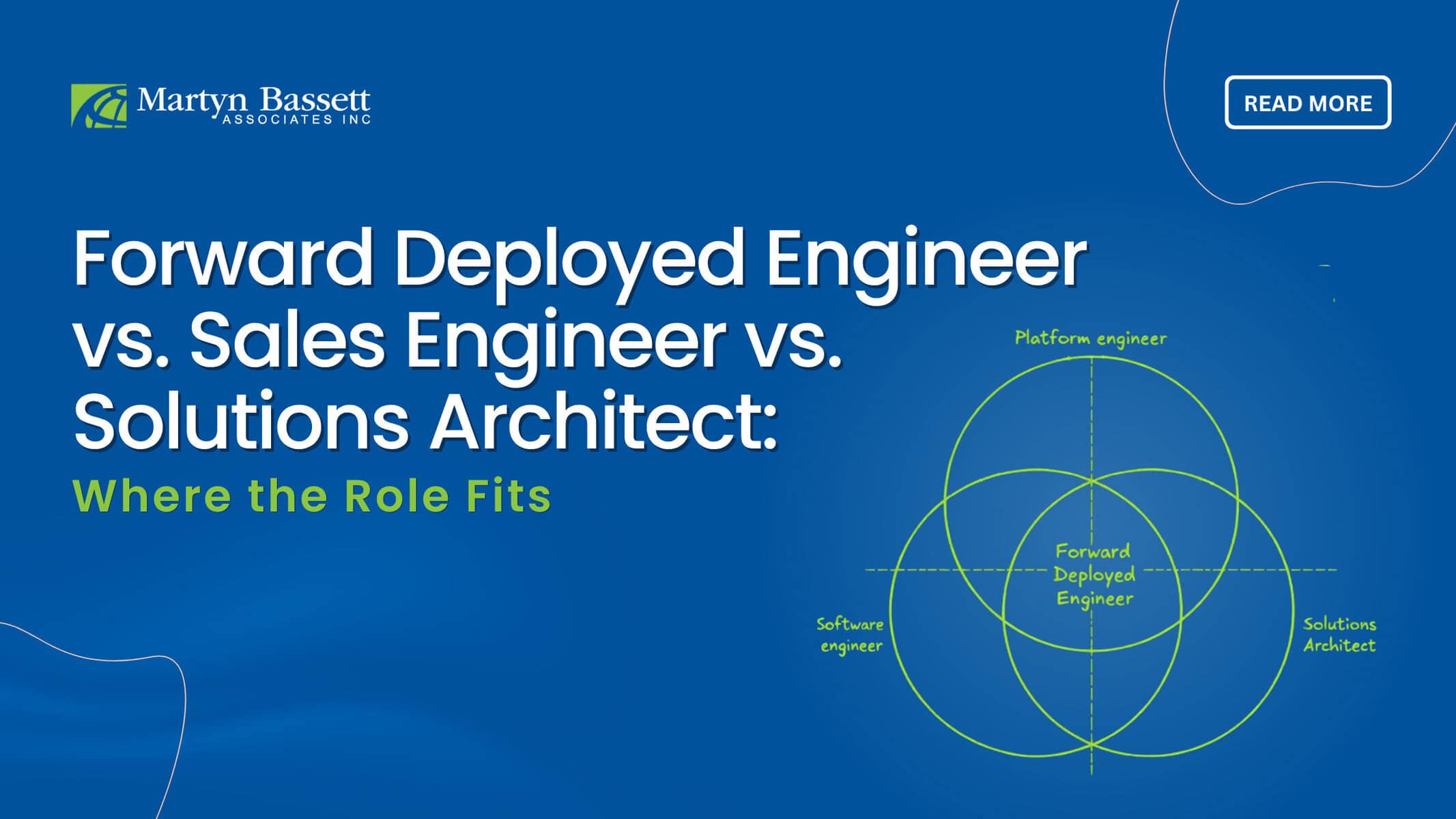
Founders often describe the same problem using different words. “We need someone technical who can work with customers and help us close and deliver.” On the surface, that sentence sounds like one hire. In practice, it can mean three very different roles, and confusing them is one of the more expensive mistakes you can make in a technical go-to-market organization.
Forward Deployed Engineer, Sales Engineer, Solutions Architect. All three involve technical people talking to customers. The similarities end there.
Why Forward Deployed Engineer Roles Look Rare
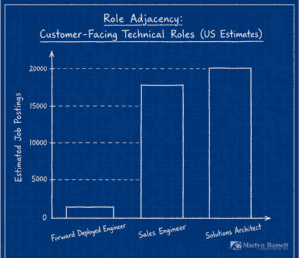
If you search job boards, you’ll see far more Sales Engineer and Solutions Architect postings than Forward Deployed Engineer postings. There’s a reason for that, and it’s not that FDEs are less valuable.
Sales Engineer and Solutions Architect roles exist at scale because they’re operationally stable. They support mature products, repeatable sales motions, and well-defined buyer journeys. You can hire ten Sales Engineers and give them roughly the same playbook. The work is defined enough to operationalize.
Forward Deployed Engineers don’t operate that way. They exist precisely because the playbook isn’t written yet. That’s why the posting count is smaller, and why demand often feels louder than the raw numbers suggest. It’s a role that shows up intensely at specific stages, then transforms or disappears as the product matures.
How These Roles Actually Differ
Sales Engineers: Helping Buyers Say Yes
Sales Engineers exist when the product is already defined but buyers need confidence before committing. Their primary job is to support the sales cycle, running demos, handling technical questions, building proof-of-concept work, and translating product capabilities into terms that map to buyer value.
They optimize conversion. They operate within known constraints. They are not product shapers, custom builders, or owners of what happens after the deal closes. A great Sales Engineer makes a well-defined product easier to buy.
Solutions Architects: Making Delivery Scalable
Solutions Architects enter the picture after the sale, when the question shifts from “will this work?” to “how do we implement this at scale?” They design customer implementations, map product capabilities to real-world systems, reduce implementation risk, and enable consistent delivery across customers.
They are not sales closers or product explorers. Their job is to turn a sellable product into a reliably deployable one. Good Solutions Architects reduce the chaos of post-sale delivery and make it possible to scale without scaling the number of fires.
Forward Deployed Engineers: Learning What the Product Needs to Become
Forward Deployed Engineers operate in a different context entirely. They show up when the product is powerful but not yet obvious, when customers need hands-on technical work to get value, and when the company is still discovering which use cases actually matter.
They work directly with customers in real environments. They prototype, configure, and adapt. They surface what’s broken, missing, or unclear. And most importantly, they feed concrete learning back into product and engineering in a way that should change the roadmap.
If an FDE’s work isn’t influencing what gets built next, the role is being misused.
The Reason FDE Postings Spike in AI and Platform Companies
In AI, data, and platform companies, the product is often genuinely powerful and genuinely hard to use out of the box. The gap between what it can do and what customers can get it to do without help is wide. Forward Deployed Engineers close that gap, not just for the customer in front of them, but by generating the learning that closes it for everyone.
This is why the role spikes in these categories. It’s not replacing Sales Engineers or Solutions Architects. It exists before them, at the stage where the product is still becoming.
What Happens to the Role Over Time
Forward Deployed Engineer is not a permanent, scalable function. As the product matures and the most common use cases become clear, the work either gets productized, moves into Solutions Architecture, or disappears entirely because the product no longer needs that level of hands-on support to deliver value.
This is a feature, not a flaw. The role is designed to be temporary in its purest form. What it produces, faster product learning, more durable use cases, better defaults, is what lasts.
The Simple Framework for Founders
If you’re still discovering what the product should be, hire a Forward Deployed Engineer. They’ll compress your learning curve and surface what’s actually missing.
If the product is clear but deals are stalling, hire a Sales Engineer. They’ll reduce friction in the buying process and help qualified buyers commit.
If deals are closing but delivery is struggling, hire a Solutions Architect. They’ll bring consistency and scalability to implementation.
If you’re trying to hire one person to do all three, the problem isn’t the organization design.
Not sure which role you actually need? Book a quick call with us. We will help you define it and hire it.