
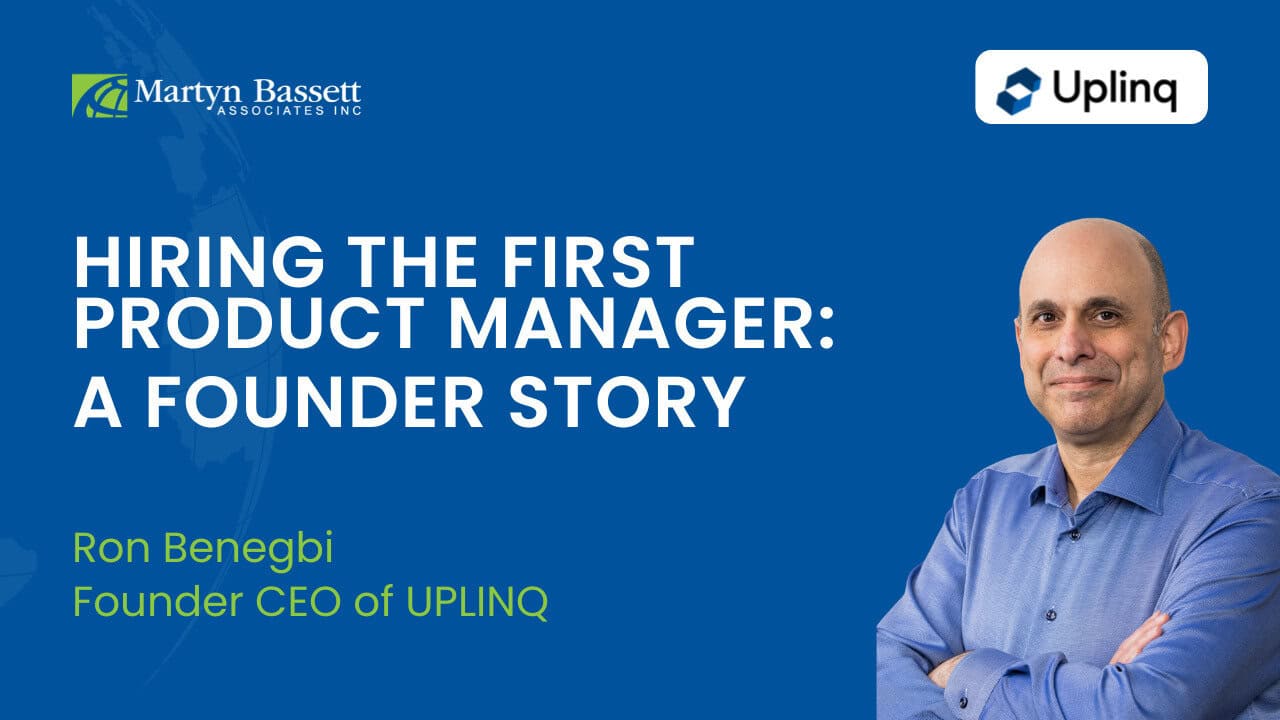
Hiring your first Product Manager is one of the most consequential decisions a founder will make.
It is rarely just a headcount decision. It is a signal that the company is shifting from founder-led product decisions to a more structured, repeatable way of building. When done at the right moment and with the right profile, it creates leverage across the business. When done too early, too late, or at the wrong level, it can quietly slow everything down.
After hundreds of conversations with founders navigating this decision, a consistent pattern emerges. The challenge is not finding product talent. The challenge is knowing what kind of product leader the business actually needs right now.
One founder who has lived this decision firsthand is Ron Benegbi, Founder and CEO of Uplinq Financial Technologies. As a multi-time founder, Ron has hired product leaders across different stages and contexts. His experience highlights the realities many first-time founders only discover mid-search.
The Real Question Is Not “Who?” It’s “When?”
Many founders assume the right time to hire a Product Manager is when engineering velocity slows or when the roadmap starts to feel overwhelming.
In reality, the right moment usually arrives earlier and feels uncomfortable.
For Ron, the inflection point came during a strategic pivot. The business needed focused product ownership while the founding team recalibrated direction. Product could no longer be a part-time responsibility shared between leadership and engineering.
That moment matters. Hiring a Product Manager before the company is ready often results in ambiguity and frustration. Waiting too long forces founders to stay in the weeds when their time should be spent on customers, capital, and growth.
The question founders should be asking is: Has product complexity reached a point where it needs dedicated leadership to move forward?
If the answer is yes, delaying the hire often costs more than making it.
What Founders Think They Need vs. What They Actually Need
When founders first define their ideal Product Manager, the requirements list is usually long.
In Ron’s case, three priorities stood out:
- Domain expertise relevant to the customer. In Uplinq’s case, lending and credit.
- An entrepreneurial mindset suited for early-stage ambiguity.
- Comfort in commercial and customer-facing moments, they had no formal sales team.
What surprised him was how rarely all three show up in a single candidate.
This is where many searches stall. Founders hold out for the perfect profile, only to realize that tradeoffs are inevitable. The goal is not to avoid trade-offs. The goal is to make them intentionally.
Strong first product hires are often defined less by perfect resumes and more by:
- Cultural alignment with the founding team
- Domain knowledge
- Comfort operating without established process
Why Seniority Is Often the Hardest Call
One of the most common mistakes founders make when hiring their first Product Manager is underestimating the level required.
Early-stage product roles often demand:
- Strategic thinking
- Stakeholder management
- Customer credibility
- Hands-on execution
That combination typically skews more senior than founders expect.
Ron ultimately hired a more senior product leader than initially planned. The cost felt significant for a venture-backed startup, but the impact justified the investment. Within the first year, the hire enabled clearer product storytelling, stronger demos, and more effective customer engagement, while freeing up founder time to focus on growth-critical priorities.
For many founders, the question is not whether seniority is affordable. It is whether the business can afford the opportunity cost of hiring too junior.
The Hidden Value of the First Product Hire
Founders often measure success through tangible outputs: roadmaps, features shipped, demos built. Those matter. But the most valuable outcome is usually less visible.
A strong first Product Manager:
- Creates focus where there was fragmentation
- Reduces decision fatigue for founders
- Acts as a bridge between customers, engineering, and leadership
- Introduces discipline without bureaucracy
In Ron’s case, the hire fundamentally changed how the company showed up in the market and how leadership allocated time. That shift is often the clearest indicator that the hire was made at the right moment.
Advice for First-Time Founders Hiring Their First Product Manager
The most important advice is deceptively simple: Do not rush the decision, but do not avoid it either. Early-stage companies have limited margin for hiring mistakes. A misaligned product hire can set a team back months. That reality makes clarity upfront non-negotiable.
Founders should be able to answer:
- What problems must this person solve in the first 6–12 months?
- What trade-offs are we willing to make?
- Is this hire meant to execute, lead, or both?
If those answers are unclear, the search will reflect that.
Getting the First Product Hire Right
At Martyn Bassett Associates, we work closely with founders to define the right first product hire before a search ever begins. That includes calibrating level, scope, and expectations so the hire accelerates the business rather than slows it down.
→ Learn how we support founders hiring their first product leader.