
The product management job market has experienced a dramatic rollercoaster over the past five years, and understanding where we are in that cycle is critical for professionals planning their next move in 2026.
The Hiring Reality: From Boom to Stall to Cautious Recovery
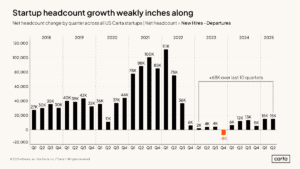
The numbers tell a sobering story. After startup headcount growth surged to unprecedented levels in 2021-22 (with quarterly net new hires reaching 111K at the peak) the market crashed hard. By Q4 2023, we hit near-zero growth, with some quarters dipping into negative territory. While 2024-25 has shown modest recovery with 12K-16K net quarterly additions, we’re nowhere near the boom years. The market has fundamentally reset.
This isn’t just abstract data, it directly impacts product management hiring. Early-mid stage software companies that were adding thousands of PM roles during COVID-era growth saw net PM hiring drop to -2,000 in 2023. The current environment shows steady but incremental growth, with companies taking a strategic, targeted approach rather than the mass hiring (or mass layoffs) of recent years.
The funding environment reflects this new reality. Seed stage investment is up, but Series A activity has contracted, while B-D stage funding increases. Translation: companies are prioritizing immediate revenue generation over speculative future growth, which fundamentally changes the types of PMs they’re hiring and the skills they value.
AI Skills: The 12-Month Revolution
Perhaps the most striking change is how rapidly AI skill requirements have evolved. Just one year ago, basic AI understanding and ML experience were sufficient differentiators. Today, companies expect familiarity with orchestration layers, AWS integration, agent development, RAG vector databases, and governance frameworks. More critically, they’re seeking PMs who can drive commercial AI revenue generation, not just build AI features.
This represents both a challenge and an enormous opportunity. The PM who invests in targeted AI skill development now positions themselves ahead of the curve. But companies remain cautious, hiring strategically for roles that directly tie to revenue outcomes.
Two Paths to Competitive Advantage
Career development now requires choosing your investment strategy: deep industry domain expertise (financial applications, healthcare, specific verticals) or technology stack expertise (developer tools, APIs, data platforms). Trying to be everything to everyone no longer works in this competitive market.
Equally important is maintaining a continuous learning mindset. Stay current with broader product landscape trends: product-led growth, emerging market dynamics, new frameworks, even when they seem outside your immediate scope. This awareness signals strategic thinking that senior roles demand.
Your Internal Path May Be Your Best Path
For many PMs, internal advancement offers the most viable growth opportunity right now. The strategy is straightforward: excel in your current role first, build strong advocacy with your manager, and volunteer for AI-adjacent projects when available. Internal moves leverage your institutional knowledge and established credibility; advantages that external candidates can’t match in a market where external hiring remains cautious.
Interview Like a PM: Apply Product Discovery to Your Job Search
The most effective candidates approach interviews as product discovery exercises. They qualify the interviewer’s actual needs, ask about specific problems the team faces, and tailor responses to those requirements. This means moving beyond generic “I can learn anything” statements to providing concrete examples using the technologies and approaches the company actually uses.
When narrating your journey, focus on outcomes: before/after growth stories, specific metrics, and real-world impact. Companies want evidence of hands-on experience, not theoretical knowledge.
Need help translating your career narrative into an impactful resume? Learn more about our Product Resume Coaching Service.
Senior Roles: The Bar Is Higher Than Ever
For those pursuing senior leadership positions, expectations have intensified dramatically. The market now demands what some call “founder mode” thinking. CPO-level candidates must combine technical granularity with strategic board-level thinking while maintaining hands-on building mentality. The days of senior PMs focusing purely on people management are over.
Actionable Next Steps
The path forward requires intentional skill investment. Consider structured learning like Product Faculty’s AI course (launching late January with OpenAI PM Miqdad Jaffer) to build systematic AI product capabilities. Ensure your resume and LinkedIn profile clearly articulate outcomes, not just responsibilities. Most importantly, treat your job search with the same rigor you’d apply to product discovery: research companies, understand their actual challenges, and position yourself as the solution to their specific problems.
Product management in 2026 will reward specialists over generalists, outcome-driven narratives over skill lists, and continuous learners over those standing still. The market has reset from its 2021-22 highs, but consistent growth is returning. The question isn’t whether opportunities exist; it’s whether you’ll be positioned to capitalize when they appear.
This summary is based on the PDMA Seattle Chapter virtual event, featuring insights from our own industry leaders, Heidi Ram and Andrew Shaw, on the evolving product management landscape. For resources and events, connect with the PDMA Seattle LinkedIn group.