
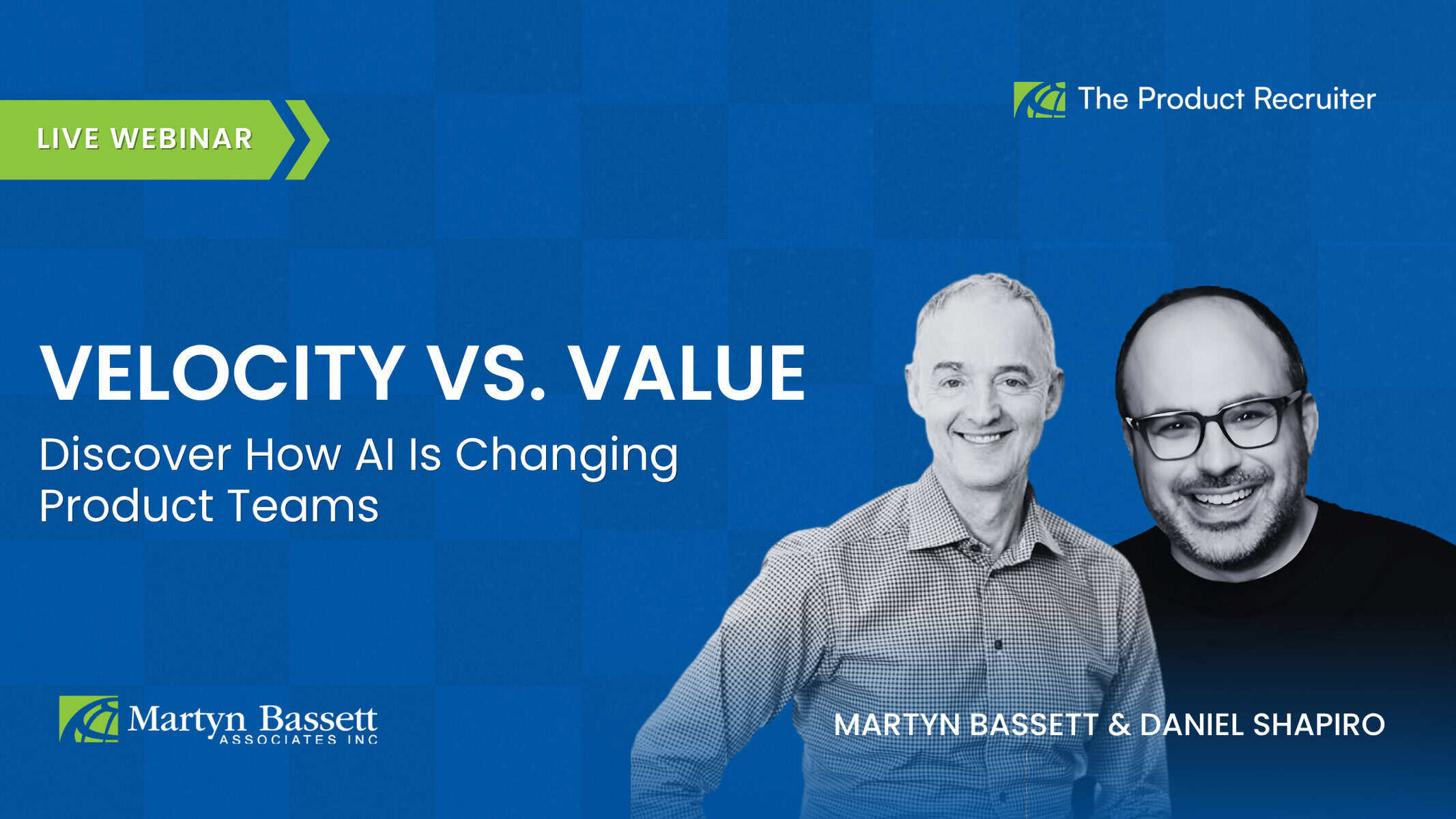
In our recent webinar, Martyn Bassett sat down with Daniel Shapiro, former CPO at Workleap and PartnerStack, to unpack how AI is reshaping product teams, product leadership, and what companies should be looking for in senior product talent today.
👉 Watch the full webinar recording
Meet the Speakers
Martyn Bassett is the founder of Martyn Bassett Associates, an executive recruitment firm specializing in building teams for early-stage and scale-up software companies across North America. Martyn and his team have been recruiting growth teams for over 20 years.
Daniel Shapiro is a product leader with 20+ years of experience building software products and scaling the teams behind them. He has served as Chief Product Officer at Workleap and PartnerStack, and has earlier career experience at Microsoft across Azure, SQL Server, and developer tools.
AI Can Bring Teams Closer to Customers — Or Further Away
One of the biggest opportunities with AI is helping product teams get closer to customers: richer prototypes, faster research synthesis, better-prepared discovery conversations.
But Daniel shared an important warning: AI should help teams talk to more customers, not fewer.
The risk is when AI-generated summaries, synthetic personas, or conversations with tools like ChatGPT and Claude start replacing direct customer interaction. The strongest product teams will use AI to improve the quality and quantity of customer conversations — not avoid them.
Velocity Is Not the Same as Value
Speed only matters if the team is moving in the right direction. In some environments, customers value frequent feature releases. In others, like B2B, healthcare, financial services and regulated industries, value may come from reliability, depth, compliance, or solving a complex workflow problem.
Product leaders need to be careful not to confuse output with impact. Shipping more features does not automatically mean the team is creating more value. The better question is: what does the customer actually value, and is the team measuring that?
The Risk of Becoming a Feature Factory
If a product team is shipping a lot but customers are not adopting, renewing, or seeing meaningful improvement, the feedback loop is likely broken.
Product leaders need to ask: are we celebrating speed, or are we measuring whether customers are receiving real value? That distinction matters. Product leaders need to make sure teams are not just moving quickly, but moving with intention toward a clear product strategy.
Product Strategy Still Requires Human Judgment
AI can summarize research, pressure-test ideas, analyze trends, and help generate options. But Daniel was clear: product strategy should not be outsourced to AI.
Strategy requires context, judgment, trade-offs, conviction, and accountability. AI can support and inform the work, but it cannot own the hard choices.
Prototyping Is Not the Same as Production
Product managers can now create realistic prototypes much faster than before, a major advantage for discovery and experimentation. But a fast prototype is not production-ready software.
Production still needs quality assurance, security, compliance, monitoring, and engineering discipline. A prototype can help a team learn faster, but it does not remove the need for technical maturity.
Thinking about your next senior product hire? Book a 15-minute call and we’ll help you define the right profile for your team.
→ Book your 15-minute call
The PM Role Is Changing
One theme stood out clearly: the rise of the builder mindset. This does not mean every PM needs to become an engineer. But product managers need a stronger understanding of how software actually gets built, tested, shipped, and maintained. The purely non-technical PM may become harder to justify in AI-enabled environments.
Companies are increasingly looking for product leaders who combine:
- Customer judgment
- Strategic thinking
- Technical understanding
- A bias toward building
- Strong product discovery habits
- The ability to connect speed to business value
Product Teams May Get Smaller, But Not Simpler
Teams have already been getting smaller over the last several years, and AI may accelerate that shift. We may see more senior individual contributors, more empowered builders, and flatter structures.
But there is no single model. A consumer startup, a B2B SaaS scale-up, and a regulated healthcare company will all need different team designs. While organizations may get leaner, the leadership challenge will not get easier.
What Hiring Managers Should Look For Now
AI is raising the bar for product leadership. The strongest product leaders need more than AI fluency; they need to use AI without losing sight of the fundamentals.
- ✅ Builder mindset — They understand how ideas move from discovery to prototype to production.
- ✅ Technical understanding — They don’t need to be engineers, but they need to understand how software gets built, tested, shipped, and maintained.
- ✅ Customer judgment — They use AI to strengthen discovery, not replace real customer conversations.
- ✅ Strategic thinking — They use AI to inform decisions but don’t outsource strategy or judgment.
- ✅ Speed with direction — They know that moving faster only matters when the team is moving toward real customer value.
Key Takeaways
- ✅ AI can help product teams get closer to customers, but it should not replace customer conversations.
- ✅ Speed only matters when it creates real customer value.
- ✅ Product strategy still requires human judgment.
- ✅ Prototyping faster does not mean companies can skip quality, security, compliance, or engineering discipline.
- ✅ Product teams may get smaller, but they will still need strong leadership and clear decision-making.
The companies that win will not just be the ones that move fastest. They will be the ones that know where to focus, what to build, and how to turn velocity into value.
Watch the full conversation: Velocity vs. Value: How AI Is Changing Product Teams →
Thinking about your next product hire? Book a 15-minute call and we’ll help you talk through what the right profile should look like.